7 min
7 min  0
0 


Читать на русском · Читати українською
“Can I buy a home in Florida if I’m not a U.S. citizen?” is one of the questions I hear most from Russian- and Ukrainian-speaking clients — both those who already live in the United States and those still abroad. The short answer is yes, in most cases: U.S. law generally does not require citizenship or residency to own real estate. But since 2023 Florida has had a law that restricts purchases by people domiciled in certain countries, including Russia, and the details matter. This guide explains who is affected, who is not, and how the buying process works for international buyers.
This article is general information, not legal or tax advice. Florida’s foreign-ownership law carries serious penalties; anyone it may apply to should consult a Florida real estate attorney before signing a contract.
The general rule: foreigners can own U.S. real estate
Non-citizens — including people with no U.S. visa at all — can generally buy, own, rent out and sell homes in Florida. You do not need a green card or a Social Security number to hold title. What changes for international buyers is mostly practical: financing, taxes, and paperwork such as proof of funds and identity.
Florida SB 264: who is restricted
In 2023 Florida passed Senate Bill 264, now sections 692.201–692.205 of the Florida Statutes (“Conveyances to Foreign Entities”). It restricts real estate purchases by “foreign principals” connected to seven “foreign countries of concern”: China, Russia, Iran, North Korea, Cuba, Venezuela (the Maduro regime) and Syria.
The key word is domicile, not citizenship. For individuals, the law targets people who are domiciled in a country of concern and are not U.S. citizens or lawful permanent residents. It also covers those countries’ governments and political parties, and companies organized in or principally doing business there or controlled by such persons.
What that means in practice:
- A Russian citizen who legally lives in Florida (domiciled here) is generally not a foreign principal under this law. In November 2025 the federal appeals court reviewing the law noted that its purchase restrictions did not apply to several plaintiffs for exactly this reason — they were domiciled in Florida (National Agricultural Law Center).
- A U.S. citizen or green-card holder born in Russia is not a foreign principal.
- A person whose permanent home is in Russia and who is not a U.S. citizen or permanent resident may be a foreign principal, and the restrictions below can apply.
- Ukraine is not a country of concern. Ukrainian citizens are not restricted by SB 264.
What the restrictions are
For people and entities covered by the law (other than China, which has its own stricter section), the main rules are:
- Agricultural land: foreign principals may not acquire agricultural land in Florida.
- Property near military and critical infrastructure: foreign principals may not acquire real property on or within 10 miles of a military installation or a “critical infrastructure facility” (such as power plants, water treatment plants, refineries and seaports, as defined in the statute).
- Residential exception: a foreign principal who is an individual may buy one residential property of up to 2 acres, provided it is not on or within 5 miles of a military installation, the buyer holds a current U.S. visa that is not limited to tourism (or has been granted asylum), and is legally present in Florida.
- Affidavit at closing: buyers sign an affidavit confirming they are not a prohibited foreign principal; title companies and closing attorneys now include it in Florida closings.
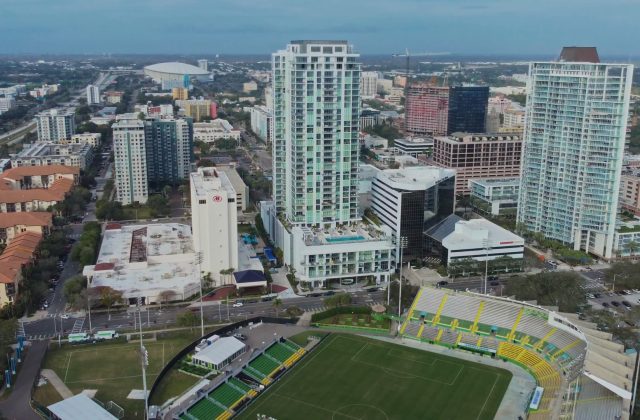
Tampa Bay is home to MacDill Air Force Base, a major seaport and many utility facilities, so these distance rules can affect large parts of the region. If the law may apply to you, have an attorney or title company map the specific property before you make an offer.
Is SB 264 being enforced?
Yes. The law was challenged in federal court (Shen v. Simpson). In November 2025 the U.S. Court of Appeals for the Eleventh Circuit ruled that the plaintiffs lacked standing and were unlikely to succeed on their constitutional and federal-preemption claims, and the plaintiffs then dismissed their case (ACLU case page; Congressional Research Service). The law remains in effect.
How the buying process works for international buyers
1. Decide how you will pay
Many international buyers pay cash. If you need a mortgage, “foreign national” loan programs exist, but they typically require a substantially larger down payment than standard loans — often 25–40% — plus documented income and assets, and sometimes an ITIN (Individual Taxpayer Identification Number). Talk to a lender who works with non-resident borrowers early.
2. Prepare your documents
Valid passport, proof of funds, a U.S. bank account (or a plan to wire funds through a reputable bank), and — if you will sign from abroad — a properly executed power of attorney with an apostille, accepted by the title company in advance.
3. Choose how to hold title
You can buy in your own name or through a company such as a Florida LLC. Each option has different tax, liability and estate consequences, and an LLC does not avoid SB 264 if it is controlled by a foreign principal. Ask a cross-border tax advisor before you sign.
4. Protect your money
Wire fraud is the biggest practical risk in real estate. Always confirm wiring instructions by phone with the title company using a number you found independently — never from an email alone.
Taxes international owners should know
- Property taxes are paid annually to Pinellas or Hillsborough County. The homestead exemption is only available for a permanent residence and generally requires legal permanent residency.
- Rental income from a U.S. property is taxable in the U.S.; non-resident owners usually need to file U.S. returns.
- Selling (FIRPTA): when a foreign person sells U.S. real estate, the buyer generally must withhold 15% of the sale price for the IRS, with some exceptions. The seller can recover any excess when filing a tax return.
Frequently asked questions
Can a Russian citizen buy a house in Florida in 2026?
Yes, if they are not a “foreign principal” under SB 264 — for example, if they are domiciled in the U.S. or hold a green card. A person domiciled in Russia faces restrictions near military installations and critical infrastructure, with a limited residential exception for holders of non-tourist visas or asylum. Consult a Florida attorney before contracting.
Can Ukrainians buy property in Florida?
Yes. Ukraine is not a “country of concern” under Florida law, so Ukrainian citizens can buy property like other foreign nationals. Financing depends on immigration status, credit history and documentation.
Do I need a green card to buy a house in Florida?
No. Non-citizens can own property in Florida. A green card mainly affects financing options and eligibility for the homestead tax exemption.
Can I buy property in Florida remotely?
Yes. With a valid power of attorney and a title company experienced in remote closings, the purchase can be completed without being physically present — but plan the paperwork and identity verification well in advance.
Buying in Tampa Bay from abroad or as a newcomer?
As a Russian- and Ukrainian-speaking Realtor, I can explain every step in your language and work alongside the attorneys, lenders and tax advisors who handle cross-border purchases. Book a free consultation, or read our guide to moving to St. Petersburg.